Páginas

quinta-feira, 31 de julho de 2014

O que significa a expressão "tit for tat"?

I was watching Friends as usual and something funny happened: Chandler walks into a room and unintentionally sees Rachel naked. After that accident, they can't get along anymore because Rachel won't get over the fact she's been so exposed. So Ross comes up with a very childish idea to try to solve the problem. He says that since he saw her boobies, he should also let her see his "peepee" [that's the term he used]. Rachel thinks for a second and then she agrees that's fair. So she says: C'mon, he's right. Tit for tat. Do you know what that means?

By the context, you must have figured its meaning yourself. But just in case, tit for tat is "an equivalent given in return, retaliation". It's much more common to see children using that expression. Just imagine a child hurts one of his friends and as a kind of repayment for that injury, the hurt kid will have the right to do the same thing. So he says: tit for tat! There are other expressions we could consider similar to that one: like for like; measure for measure; an eye for an eye; a tooth for a tooth; blow for blow. That's it for today guys. Take care!

To be on the fence about something: o que isso significa? [expressão dita no seriado Friends]

Here's what was going on in one of the episodes of Friends when an expression came up: Chandler and Monica are looking to buy a house and while they're talking to the house seller they find out Janice, Chandler's ex-girlfriend, is about to buy the house next door. When Janice sees them, she gets shocked by such coincidence and confesses she was on the fence about the house, but now that she knows her new neighbors she can't wait to get it. But wait, have you ever heard of the expression "to be on the fence about something" before?

When you're on the fence, it means you're undecided about something. So imagine you have a big decision to make like what house to buy and you're not sure what exactly you want yet. Maybe you need to look for more houses, try different neighborhoods or consider living somewhere closer to your job. Whatever the reason might be, there's something that puts you on the fence, you can't decide. There are many situations where that can happen. Try to think of this: Now that you're about to go on vacation, you're thinking of travelling to a foreign country. The thing is, you're on the fence about which country you'd like to go to: Mexico or Canada. That's it for today guys. Take care!

quarta-feira, 30 de julho de 2014

Um uso menos conhecido do adjetivo funny

I was watching a movie the other day when I heard the word funny in a less conventional way. If you're a beginner, I encourage you to keep reading. Here's what was happening when the word came up: After witnessing the death of a friend, some guy had to break the bad news to the deceased's girlfriend. When he approached her to tell her about the unfortunate news, she noticed a very different expression in his face and saw that something was wrong. So she said: Why do you look so funny?

If you're not used to that way of using the word funny, you must have found it weird for someone to look funny when he's about to tell such bad news. I mean, what's funny about saying someone has died? The thing is, in that case funny means weird, odd, something strange. It's not that he was making funny expressions or laughing in the most inappropriate moment. He looked funny because he looked different from the usual, a little bit odd. It's very common to hear many English speakers using the word funny as synonymous with weird. You'd better get used to it.

Here are some other examples: 1) you walk into a room and you feel a different and strange smell, so you say: what smells so funny? 2) you taste some different food for the first time and then you find it really weird, so you say: what's in it that tastes so funny? That's it for today guys. Take care!

terça-feira, 29 de julho de 2014

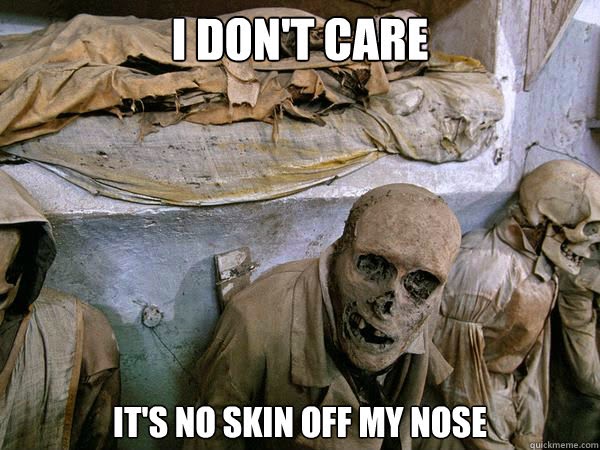
O que significa a expressão "it's no skin off my nose"?

One of these days while I was scrolling down on twitter, I saw someone saying something like: It's my twitter and I can post anything I want on it. If you don't like it, feel free to block me. It's no skin off my nose. We can see that person was a little upset at people trying to tell her what she should say on twitter. But can you understand what she meant by "it's no skin off my nose"? Let's find out!

When you say it's no skin off your nose, it means you do not care about something because it will not affect you. In other words, that's just a more enthusiastic way of saying "I don't care". You don't have to be angry or rude to use that expression like that person I mentioned from Twitter. You might also simply be saying that you don't mind something, that you're okay with whatever people decide for you. For example, you go out with your friends and now that it's time to go back home, they're trying to decide whose car you're going in. You really don't care which car that is as long as it takes you home. So you say: I can go in his car if he prefers. It's no skin off my nose. It's also possible to see people saying "it's no skin off my teeth", but that's very informal. That's it for today guys. Take care!

O que significa a expressão "someone's heart is in the right place"?

I was watching a sitcom when an intriguing situation was created: There's a man who's trying his best to make his girlfriend forgive him for a couple of stupid things he's done. While talking to a friend of his, he remembers his girlfriend loves surprises and comes up with the idea of secretly arranging a wedding party. The thing is, he hasn't even proposed to her girlfriend yet and decides to do that on the same day as the wedding.

When the day comes and he finally puts his idea into action, his girlfriend can't believe how much of a stupid idea that was. She said she likes surprises, but being surprised by a wedding is nuts. Then she tried to calm herself and recognize the gesture of goodwill of her boyfriend. Here's what she said when everything was settled: I know your heart is in the right place, but you had to ask me first. When someone's heart is in the right place, it means they mean well even though what they did doesn't seem like it. It's like trying to please someone by doing something over the top like secretly throwing a wedding party. The intentions are good, but there's lack of good sense.

You can also use that expression to describe anyone kind that occasionally has bad attitudes. Imagine you have a friend who's very annoying. He has no idea when he's crossing the line or when he's doing something that may be hurting someone else, but you think that he's not actually a bad person; he's just immature. One day somebody tries to speak ill of him, and you defend him by saying: You have to be patient with him sometimes, but his heart is in the right place. That's it for today guys. Take care!


domingo, 20 de julho de 2014

O que significa "to leave someone/something in the air"?

Yesterday, I was talking to a cousin of mine trying to set a time and place to meet before leaving for a skating event today. Although the conversation went on and on for quite a lot of time, it seemed we never got to what really mattered. So I told him: Please don't leave me up in the air. Nothing has been decided on when and where we're meeting tomorrow for the event. Do you understand the expression in bold text?

When you're left up in the air, it means you've been kept waiting for a decision. That happens when you need other people to reach an agreement but for some reason they can't. Maybe because they don't agree with your suggestions, they don't care for what's being discussed, they want things done their way, and so on and so forth. The thing is, when you're in a situation like that, you can say you don't want to be left up in the air, because in some way that decision you're waiting for is important to you.

Here's a different situation: You've been set up with a group for a very important assignment in school, and now you're trying to decide whose place the meetings will be held at. The problem is that everybody seems to have a problem at home. You're having your house renovated, one of your classmates' house is too small, the other's too noisy, etc. You think that'll delay the assignment forever and your group needs to get that matter settled immediately. So you say: Let us not leave this up in the air til the last minute, any place will do for now. When you leave a decision like that up in the air, you leave it undecided. It's like leaving something drifting in the air, moving neither up nor down. Actually that's what the expression alludes to. Many people have a hard time making decisions, they have a tendency to leave everything up in the air. That's it for today. Take care!

sábado, 19 de julho de 2014

O que significa "the bearer of bad news"?

One of these days, while I was watching an american sitcom, I heard a very useful expression. Here's what was going on when it came up: a woman was at a neighbor's party trying to fit in when on her way to the bathroom she unintentionally saw the party host's husband kissing another woman. She didn't think twice before telling his wife about what had just happened. Here's what she said when she approached her: I hate to be the bearer of bad news, but I just saw your husband kissing another woman. Do you know what the bearer of bad news means? Read on!

When you're the bearer of bad news, you're the first person to tell someone about something bad. Nobody likes to be that kind of messenger because they know delivering bad news can ruin anybody's day. So imagine you're going on a trip to Europe with your family and everybody's looking forward to it. When you're only one day to go, you receive a call from the airline company saying your flight's been canceled. You're very sad to have to be the first person to deliver such bad news to your family, but here's what you say: I don't like to be the bearer of bad news, but we're going to have to postpone our trip for a couple of weeks.

Delivering bad news like that can cause a lot of anxiety. Imagine how difficult it is for doctors to deal with the job of being the bearer of bad news every time something bad happens to their patients and they have to tell it to their families. Do you have a story like that to tell us? Leave them down below on the comment section. Talk to you next time!

sexta-feira, 18 de julho de 2014

Como dizer "ter sangue de barata" em Inglês?

I was watching TV the other day when one of the characters in a soapopera said: eu não tenho sangue de barata. That made me wonder how we say that in English. Do you have any idea? If not, keep reading. Here's what was going on in the soapopera when that expression came up: A man was really mad because some people were ploting against him thinking that he would never react to their provocations or that he's too scared to fight. When you're in a situation like that, you can say "you're not milk and mild". Let's think of a different example.

Imagine your boss treats you badly in front of your coworkers. He yells at you, makes you do things that's not part of your job and even teases the way you act, speak and work. He's definetely crossed the line. While you're talking to one of your coworkers about it, who's also a close friend of yours, he tries to open your eyes and make you stand up for your. Here's what he says: I don't think you should put up with the humiliations just because he's your boss. I know you need this job, but prove him you're not milk and and mild!" About the vocabulary in the expression, mild refers to someone very gentle, softhearted, calm and gentle. Those are actually all synonymous with mild. As for milk, that can be an analogy with the way a gentle person is: smooth and soft. That's it for today guys. Take care!

quinta-feira, 17 de julho de 2014

O que significa "littering"?

Since I talked about a very common sign on the previous post, I thought it'd be a good idea to insist on that topic. During the World Cup here in Brazil, signs in English were very common around the cities where the matches were being played. While I was watching one of the many news reports on that big event, I saw right behind the newsman a sign reading "no littering please". Do you know what that means?

To litter means to make a place or area untidy with rubbish or a large number of objects left lying about. For example, you go to a beach and see a sign that says "no littering" or "please do not litter here". That means they don't want you to leave any kind of object or trash on the beach. They expect you to be decent enough to pick up after yourself, that is to say, to clean up your own mess. Littering can be even a crime in some places.

If you litter a place, you do not necessarily make it dirty. The simple act of taking the objects out of order and making the place untidy can be what we call littering. So imagine you have a wife that throws all her clothes around the room every time she wants to pick something to wear. You can say her clothes littered the room because they made a mess out of it, they made the room look like hell. The room is littered with clothes. On Twitter, someone wrote "If I was a police officer, I would just drive around and give people tickets for littering. That's all I would do." He was just trying to express how upset he is at people who have the habit of throwing trash on the streets. That's all for today guys. See you next time!

O que significa "loitering"?

Imagine you're in one of the hallways of a hospital when you bump into a sign that says "no loitering". What would you think that means if you'd never heard of that word before? Loitering means to stand or act aimlessly and idly. In simpler words, it means to do absolutely nothing, to remain in a place wasting your time with nothing to do. The reason people hang signs saying "no loitering" at certain places is that it is inconvenient [and even illegal in some situations] to have people hanging around. Just imagine how bad it can be for people at a hospital to have to walk down the hallways having to deal with so many people in the way. It is irritating and it could even be dangerous for people who are there for an emergency. So that sign reminds you that if you have nothing to do at the hospital, you should immediately leave.

"No loitering" signs can be found in many other places besides hospitals. But while loitering can be considered illegal in those areas, there are many places where you can go to when you have absolutely nothing to do. For example, a lot of people spend many hours of their time loitering around shops without actually buying anything. They're just there existing, maybe only window shopping, but with nothing important to do. When teenagers are bored, they usually get together to loiter around the neighborhood, maybe they go to a park where they can sit and talk. On Twitter, I saw someone saying that after reading a sign saying "no loitering", he realized he was loitering his way through life. That's an exaggerated way he found to say that maybe he's not been doing anything important in his life. Maybe he's unemployed and has a lot of spare time to be filled with loitering. That's it for today guys. And it's okay if you want to loiter around my blog. There's a lot more to see. Take care!

quarta-feira, 16 de julho de 2014

O que significa "to stoop low"? [expressão tirada da música Somebody that I used to Know, de Gotye]

Today I have an expression I got from the very famous song "Somebody that I used to know", by Gotye. I'm sure you've heard about it before and chances are you're a big fan of that singer. The song talks basically about a man who's just got out of a troubling relationship. Despite not loving his ex anymore, he didn't expect her to leave his life in a way that made it seem like she's become only "somebody that he used to know". In one of the lines, he says as if talking to her: but you didn't have to stoop so low. Do you know what "to stoop low" means? Let's find out!

When you stoop low, it means you've willingly fallen to a level of a person with low morals, you've done something that's considered wrong by some. In the case of the song, what made that brokenhearted man think his ex stooped so low was that she was treating him like a stranger, she even had her friends collect her records and changed her number. In other words, he wouldn't mind breaking up with her as long as she didn't erase him from her life as if he'd meant nothing. Have you gone through a situation like that with any of your exes? In what way have they stooped low? That expression applies to any kind of situation where someone does something that in your opinion is very wrong, even unethical. Imagine you have a friend you trusted very much and then you heard he's been secretly going out with your girlfriend. You never dreamed in your wildest dreams your best friend would be capable of doing such a bad thing to you. Your friend stooped very low. He has no morals whatsoever. That's it for today guys. By the way, take this chance to enjoy the song I've been talking about:

sexta-feira, 11 de julho de 2014

Como se diz goleada em Inglês?

Não precisaria nem dizer de onde tirei a inspiração para criar este post, certo? Depois duma vitória esmagadora sobre o Brasil, a Alemanha acabou desencadeando uma onda de matérias jornalísticas que poderiam muito bem vir em destaque através deste título: Brazil gets hammered by Germany. Você consegue entendê-lo?

Em Inglês, To get hammered/thrashed equivale ao que nós dizemos "levar/tomar goleada" em Português. Portanto, o título acima em destaque da matéria em Inglês que eu criei seria "Brasil leva goleada da Alemanha". Se você percebeu bem, essa expressão está na voz passiva, isto é, o sujeito não é quem pratica a ação, mas o agente da passiva. Para convertê-la em voz ativa, usamos simplesmente to hammer/thrash, o que resultaria em "Germany thrashed/hammered Brazil" [Alemanha deu uma goleada no Brasil.] Simples, não é? Talk to you next time!